

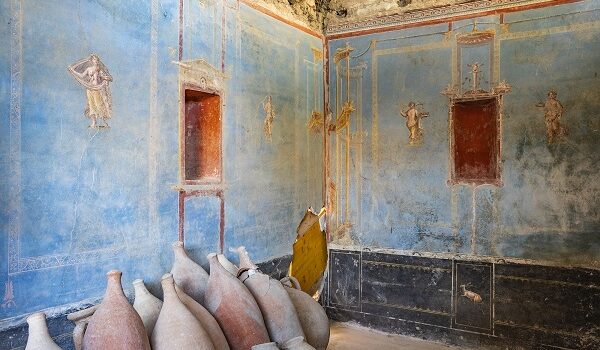
How much did the blue paint on the walls of Pompeii actually cost? A study published in the journal npj Heritage Science reveals the high cost of the precious pigment
Estimates carried out on the walls of the “Blue Sacrarium” of Regio IX in Pompeii
reveal that the costs of the blue pigment alone
came to between 50% and 90% of a Roman legionary’s monthly pay.
The “blue sacrarium” in Regio IX,10 is the subject of a scientific article that has just been published in the leading journal npj Heritage Science. The scientific analysis, carried out by MIT (Massachusetts Institute of Technology) together with the Archaeological Park of Pompeii and the University of Sannio, examined the blue pigment used to decorate the walls of the room (the famous Egyptian blue or caeruleum as it was known by ancient Romans).
Multi-scale X-ray microscopy of the pigment, which involved several investigative methodologies (ranging from non-destructive to micro-destructive methodologies, from the atomic to the macroscopic scale) has led to the quantification of the exact amounts of paint applied using the fresco technique. It is therefore possible to estimate the significant costs of the pigments used for decoration and compare them to the cost of living for ancient Romans. Estimates reveal that the costs of the blue pigment alone came to between 50% and 90% of a soldier’s monthly pay.
The study emphasises the need for integrated diagnostic research to gain a better understanding of the ancient world from the pictorial and symbolic perspective, without neglecting the more practical, economic aspects.
For further information, see:
https://www.nature.com/articles/s40494-026-02349-2


