

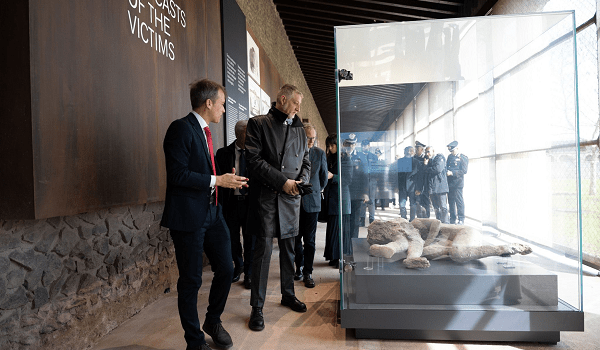
The plaster casts of Pompeii: an itinerary through the eruption of AD 79
For the very first time, a permanent exhibition recounts the origin, history and technique of the plaster casts of Pompeii.
From 12 MARCH – PALESTRA GRANDE
“Since the anguish of each belongs to us all
We’re still living yours, scrawny little girl
Clinging convulsively to your mother (…)
The centuries have passed, the ash has turned to stone
Locking in these gentle limbs forever,
So you stay with us, contorted plaster cast,
Endless agony, horrific witness”
Primo Levi – The Girl of Pompeii -
“They have been dead for eighteen centuries, but they are human beings seen in their agony. This is not art, it is not imitation; these are their bones, the remains of their flesh and their clothes mixed with plaster: it is the pain of death that takes on body and form…. “
Luigi Settembrini – 19th-century Neapolitan writer and patriot
A memorial that tells the story of the fate of Pompeii and its victims. The eruption of AD 79 – which affected thousands of people and turned the ancient Vesuvian city into a unique piece of historical evidence – is illustrated for the very first time in a permanent exhibition that captures the key moments, displays the plaster casts of the victims and a selection of extraordinarily well-preserved organic finds, and will be open to the public in Palestra Grande from 12 March 2026.
The new exhibition, which presents the origins, the history of the eruption and the technique of making plaster casts, is the result of a dialogue between the language of museum communication aimed at giving dignity to the victims of the eruption and the intention to tell the story with scientific precision.
The objective narrative of the events brings visitors face-to-face with the “… pain of death that takes on body and form” to use the words of the writer Luigi Settembrini who in the nineteenth century described the plaster casts of Pompeii in the following way: “This is not art, it is not imitation; these are their bones, the remains of their flesh and their clothes mixed with plaster”; an “endless agony, horrific witness” described by Primo Levi in his poem The Girl of Pompeii.
22 plaster casts of victims, of the various artefacts on display, selected from the most well-preserved and clearly intelligible ones, are presented on the basis of the context of provenance, which ranges from the domus (houses) in the areas within the city as far as the gates and to the roads that departed from the residential centre, along which the inhabitants tried to seek refuge albeit in vain.
The exhibition brings together a wide range of evidence for the very first time. From the nineteenth century, it proved possible to create about a hundred plaster casts in Pompeii. Other plaster casts, either individual ones or arranged in small groups, can be seen in the domus or in other buildings of the city, in the original places where they were found.
The itinerary unfolds within the southern and northern porticoes of Palestra Grande, the large square building situated opposite the amphitheatre which was once used for the athletic training of the city’s inhabitants, with a section devoted to Vulcanology and to organic finds, plants and animals and a section devoted to human remains.
The origin of the plaster casts
In AD 79, the eruption of Vesuvius suddenly destroyed the city of Pompeii, burying it beneath metres of ash and pumice. This catastrophic event led to the preservation not just of buildings and streets, but also of traces of the lives of the inhabitants. The people trapped beneath the ash were rapidly covered by a cloud of hot volcanic material which solidified around their bodies.
Over time, the bodies and all the organic materials decomposed, leaving voids within the hardened ash. In the nineteenth century the voids were filled for the first time with plaster in order to create faithful casts of the victims and now provide a powerful, moving record of the tragedy, enabling us to “see” the objects that were destroyed and the people who lived and died in that fateful instant.
The plaster casts are therefore not just simple artefacts but offer first-hand testimony to the tragedy that struck Pompeii. With the aid of scientific techniques, the plaster casts provide us with the faces, gestures and humanity of the inhabitants of the ancient city, frozen in the exact instant in which time came to a standstill.
The exhibition itinerary
The south wing contains a section on vulcanology, devoted to Vesuvius and the story of the eruption of AD 79, enriched by a new video which provides a brief illustration of the dynamics and the reconstruction of a column of about 4 metres of ash and lapilli, the volcanic material from the eruption that completely buried the city of Pompeii. This is followed by a part devoted to animals and plants with a collection of extraordinarily well-preserved organic materials which shed light on the relationship between humans and natural resources.
The section is accompanied by panels with texts and illustrations of the flora and fauna that appears in the famous frescoes of Pompeii, some of which have only recently been discovered (such as those from the House of Thiasus).
The north wing, besides a small area devoted to furnishings with two casts of doors, contains the large section devoted to human remains, which displays a collection of original plaster casts of the people who perished in the eruption.
The plaster casts of the victims of AD 79 constitute the most famous and touching form of evidence from Pompeii. Often mistaken for petrified bodies, they are actually the result of a unique process, made possible by the conditions created by the eruption and by an archaeological technique that has evolved over time.
Even though attempts are known to have been made previously, it was in 1863 that the archaeologist Giuseppe Fiorelli became the first person to succeed in recreating the original forms of the victims by pouring liquid plaster into these cavities. Once the plaster had hardened and the surrounding ash had been removed, surprisingly detailed human figures re-emerged, often with their bones still present within them.
The theme presented in the exhibition and the type of finds on display bring us face-to-face with the moment of sudden death. For this reason, the section devoted to the victims is not immediately visible, but is protected at the two edges by partitions with notices warning visitors that they are about to enter a remarkably sensitive area, giving them the opportunity to choose whether to go ahead with the visit or not.
The exhibition features panels where the use of colour and decoration is reduced to a minimum, prioritising linear texts accompanied by archive photographs that document the contexts or the casts during the excavations and restoration work. It is enriched by multimedia contents: on the one hand, these are devoted to the technique of creating plaster casts from their invention to the present and to the internal structure of the casts with images captured by CAT-scans carried out on several examples. On the other hand, they look at historical details such as the interview with Amedeo Maiuri about the casts from the Orto dei Fuggiaschi (Garden of the Fugitives) or the emotional aspects linked to the sight of these finds, as is so well portrayed in the extract from the film “Journey to Italy” by R. Rossellini.
A flexible and accessible itinerary: videos in LIS and ISL (sign languages) and small tactile models
Due to its location within the archaeological site, the whole itinerary is intentionally flexible. In other words, it is designed to be visited and understood in various directions and regardless of the point of entry to the monument, so that it can adapt to the different directions of the flows of visitors.
Particular emphasis has been given to accessibility, through audio contents, videos in LIS and ISL (International and Italian sign language), AAC (Augmented and Augmentative Communication) and two tactile sections devoted to the part about human victims and the part about animals and plants with small 3D models of the finds accompanied by texts in braille.
By means of the illustrative panels and graphics, the videos and in-depth analyses, the exhibition is designed to ensure the widest possible access to these unique materials, respecting and enhancing their distinctive features, giving them back the rightful role as extraordinary pieces of evidence about the history of Pompeii and its inhabitants.
At the end of the opening ceremony, the exhibition will be open to the public.
The visit to the exhibition is included in the entrance ticket to the excavations
Recommended entrance: piazza Anfiteatro


