

Pompeii, scenes of gladiators and love stories. Snapshots of life emerge thanks to advanced technology
After two centuries, new discoveries made in the corridor by the theatres
“Why the future of memory depends on technology”
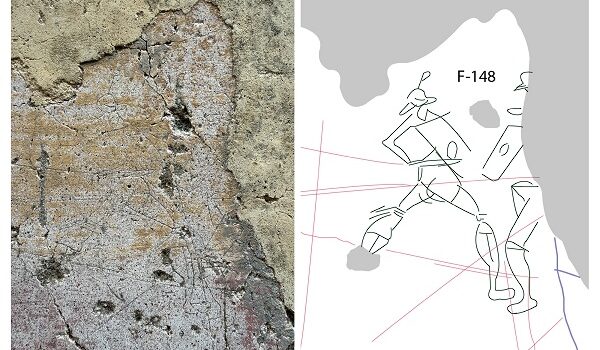
A love story of a woman named Erato, Erato Amat… (Erato loves...), a scene of gladiatorial combat, and many other moments and feelings set down on a wall in the theatre district, akin to what we would find today on the walls of modern streets or in online chats and social media platforms. Stories of real life, love, passion, insults and sporting slogans that would have been lost forever but which are instead beginning to emerge at Pompeii thanks to technology.
This is what is happening in the corridor that linked the theatre district to via Stabiana. A wall excavated over 230 years ago, which millions of visitors pass by every year and from which no one expected any new information or no further stories and where – through the use of state-of-the-art methodologies – almost 300 inscriptions have emerged, including some that have long been known about (roughly 200) and newly identified ones (79).
The project entitled “Bruits de couloir” (Rumours) was conceived by Louis Autin and Éloïse Letellier-Taillefer of the Sorbonne and Marie-Adeline Le Guennec of the University of Québec in Montreal, in collaboration with the Archaeological Park of Pompeii. As published in the E-journal of the Excavations of Pompeii https://pompeiisites.org/e-journal-degli-scavi-di-pompei/, the project was carried out in two campaigns in 2022 and 2025. This led to a comprehensive reinterpretation of the vast amount of evidence from the graffiti in this corridor, using a multidisciplinary approach that combines epigraphy, archaeology, philology, and the digital humanities.
“I'm in a hurry; take care, my Sava, make sure you love me!”– “Miccio-cio-cio, your father ruptured his belly when he was defecating; look at how he is Miccio!" – “Methe, (slave) of Cominia, of Atella, loves Cresto in her heart. May the Venus of Pompeii be favourable to both of them and may they always live in harmony”. These are some known examples of graffiti which attest to the vitality and multiplicity of interactions and forms of sociality that developed in a public space frequented by the inhabitants of ancient Pompeii.
“Technology is the key that is shedding new light on the ancient world and we need to inform the public of these new discoveries,” says Gabriel Zuchtriegel, the Director of the Park of Pompeii. “We are working on a project designed to protect and improve understanding of the graffiti, which number over 10,000 across all of Pompeii; an immense legacy.Only the use of technology can guarantee a future for for all this memory of life lived in Pompeii”.
The methodology employed uses a virtual grid, documenting spatial and thematic links between the inscriptions. Lastly, it offers complete coverage through RTI (Reflectance Transformation Imaging, a computer-aided photographic technique that captures a series of images of an object illuminated from different directions) of both walls of the corridor. These instruments have revolutionised the analysis of both texts and images, simultaneously ensuring the digital preservation of a collection of evidence, which is, by its very nature, extremely fragile.
The development of a 3D platform that combines photogrammetry, RTI data and epigraphic metadata will lead to the creation of a new instrument for the joint visualisation and annotation of the inscriptions. In order to facilitate the conservation of this important complex of inscriptions from Pompeii concentrated in a single area, and brought to light in 1794, the Archaeological Park of Pompeii is completing the design, now in its final stages, of a system of roofing for the corridor that will protect the plaster on which the inscriptions were made, thereby ensuring the experience of future tours enhanced by technologies developed using new research methods.


