

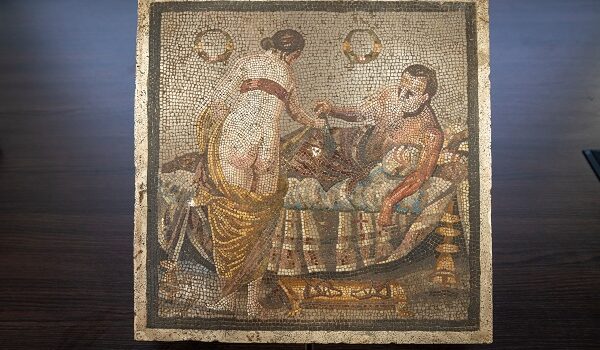
The cold case of the mosaic portraying two lovers given back to Pompeii, once a gift made by a captain of the Wehrmacht to a German citizen, has been shown to come from a Roman villa in Le Marche
Research carried out by the Archaeological Park of Pompeii with the University of Sannio
has pieced together the story.
Details of the story emerge from the study published today in the E-journal of Pompeii
Discoveries of artefacts, their unexpected movements over time and as a result of historical events, sometimes become the subject of actual investigations which, thanks to the research carried out by archaeologists and restorers, have led to the truth and enable them to be assessed within the right historical context. This is the case for the mosaic depicting an erotic scene that was stolen by a captain of the Germany army during the Second World War, according to the reconstruction of the Carabinieri cultural heritage protection squad, and later handed over in July 2025 to the Archaeological Park of Pompeii.
The mosaic actually came from a Roman villa in Le Marche, as has been confirmed by subsequent studies conducted by the Park together with the University of Sannio.
The story begins with a gift to a German citizen by an army captain, a friend of his, who brought it to Germany after it came into his possession during his work as a member of staff of the military supply chain in Italy in 1943/44. His heirs decided to return it to the Italian state.
Given the lack of information about the provenance of the mosaic, the Italian Ministry of Culture decided to hand it over to the Archaeological Park of Pompeii, given that the mosaics displayed similarities in terms of technique and style from the Vesuvian area. Exhaustive research carried out by the Park subsequently led to an unexpected result: the mosaic has no ties with Pompeii. The archaeometric analyses conducted in conjunction with the Department of Science and Technology of the University of Sannio suggest that it was made in Latium (modern day Lazio) and was sold across different regions within the Italian peninsula. However, the story does not stop there: a chance encounter, during the presentation of the artefact in 2025 with Giulia D’Angelo, an archaeologist originally from Le Marche and the co-author of the study published today in the E-journal of Pompeii, has led to the identification of the true origins of the mosaic: it comes from a Roman villa in Rocca di Morro, a district within the municipality (comune) of Folignano in Le Marche, where there are records for its presence from as early as the late eighteenth century.
“The reconstruction of the events surrounding this mosaic shows that the protection of cultural heritage does not end with the material recovery of the artefact, but continues with rigorous study, scientific research and the identification of the historical truth. The combined work of the Carabinieri’s Cultural Heritage Protection Squad, together with the staff of the Italian Ministry of Culture, the Archaeological Park of Pompeii and the University have made it possible to place the mosaic within its original context, a Roman villa in Le Marche. Each item of cultural heritage stolen and brought back to Italy represents a fragment of our identity which is thereby returned to society”, stated Alessandro Giuli, Minister for Culture.
“This story gives back to Folignano a precious fragment of its past and strengthens the close ties between our community and its ancient history” said Matteo Terrani, mayor of Folignano. The fact that the work comes from a Roman villa in Rocca di Morro adds new importance to a symbolic place that is a fundamental part of our identity. Our administration is working, together with amateurs and volunteers, to promote initiatives designed to enhance the site. In the next few weeks, we shall go to Pompeii to inspect the mosaic and meet Gabriel Zuchtriegel, the Park Director, whom I would like to thank for his helpfulness and professional expertise, with the aim of setting up a constructive dialogue and opening up new prospects for collaboration”.
Evidence about the artefact also re-emerges in the work of Giulio Gabrielli (1832- 1910), a painter and archaeologist from Ascoli who depicted it in a handwritten notebook (c. 1868), now kept in the town library of Ascoli Piceno. Gabrielli’s sketch is accompanied by notes about the mosaic and the site of discovery. He interprets the scene as that of a man “who offers with his r[ight] hand a bag of money … to a beautiful half-naked woman standing in front of him”, suggesting as a title The leave-taking of a prostitute and adding that the artefact “was found on farmland belonging to the Malaspina family in Rocca di Morro”.
“In order to evaluate future initiatives for enhancing the mosaic (such as an exhibition) together with the community and local authorities in the area of provenance”, adds Marco Fioravanti, mayor of Ascoli Piceno, “the results of the research are presented in the e-journal of the excavations of Pompeii published today. We are extremely satisfied that, thanks to the interdisciplinary work of the Carabinieri, the staff of the Italian Ministry of Culture, archaeologists and researchers with specialist archaeometric skills, it has proven possible to reconstruct a complex story which has a happy ending”.
“Reconstructing history is the result of great teamwork and this is an example of how dedication, professionalism and passion can lead to unexpected discoveries not just in Pompeii, but also in less well-known sites, furthering our understanding of our classical heritage and enhancing it throughout Italy”, declared Gabriel Zuchtriegel, Director of the Archaeological Park of Pompei. “Recent studies have shed light on a specialist workshop in the area of Latium (present-day Lazio) that exported precious mosaics, presumably made in large quantities, to areas like Le Marche, Campania and Puglia; it is an extremely interesting discovery, not just for the history of Roman art, but also for the economic history of the Roman world.”
Go to the following link https://pompeiisites.org/e-journal-degli-scavi-di-pompei/ to read the full article in the E-journal published today by Giulia D’Angelo (Sapienza University of Rome, Department of Science and Antiquities), Celestino Grifa (University of Sannio, Department of Science and Technology; SHerIL, Samnium Heritage Innovation Lab.), Simona Boscia, Andrea Lepore, Chiara Germinario, Mariano Mercurio (Department of Science and Technology, University of Sannio), Gianluca Frija (University of Ferrara, Department of Physics and Earth Sciences), Alessandro Russo, and Gabriel Zuchtriegel (Archaeological Park of Pompeii).


