

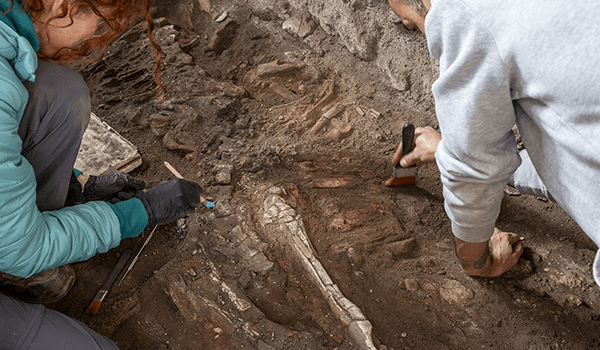
New investigations in the House of the Chaste lovers: the excavation of a room used for bread-making has unearthed the skeleton of an equid
Archaeology and archaeozoology reconstruct the role of animals in daily life and during the final hours of the eruption of AD 79.
The skeleton of an equine has been unearthed during excavation work carried out in a room used for bread-making within the Casti Amanti complex in Pompeii.
The project was carried out in close collaboration between archaeologists and specialists from the Applied Research Laboratory – an archaeozoologist, an archaeobotanist and an anthropologist – as part of an interdisciplinary approach that today represents one of the most defining aspects of archaeological research. In particular, archaeozoology enables us to reconstruct how animal species were utilised in the ancient world, providing valuable insights into production systems and the role animals played in daily life.
The Insula of the Chaste Lovers is one of the most important excavation sites in Pompeii because it contains an entire bakery production complex with an oven, storerooms and processing areas, as well as the owner’s residence. The complex, famous for the fresco of the ‘chaste kiss’ discovered in a triclinium of the residence and which gives the insula its name, also includes adjoining stables, where other equines used to turn the millstones and transport the wheat needed for bread production had already been found.
The excavation represented the first phase of the investigation, and following this, initial studies of the materials found. Laboratory analyses, which are still ongoing, will provide further data both on the animal’s role within the production context and on the conditions in which it found itself at the time of the eruption of Vesuvius in AD 79.
The study of the equine may also contribute to our understanding of the eruptive dynamics and the animals’ reactions to the catastrophic events that engulfed the city, adding another step towards reconstructing those last dramatic hours. It demonstrates how Pompeii offers an extraordinarily well-preserved context, allowing us to investigate ancient life systematically, reconstructing the relationships between urban spaces, production activities, individuals, and animals.
The research continues through the study of artefacts and laboratory investigations in a continuous dialogue between different disciplines, to give a voice to the silent remains and to remind us that every piece of evidence – human or animal – holds a story yet to be told.
‘For a long time,’ says director Gabriel Zuchtriegel, ‘Pompeii has primarily represented the beauty of the frescoes, the opportunity to study the material culture of antiquity. In reality, it is much more: it is the chance to learn about the human lives that were cut short during the eruption, as in the recent exhibition of plaster casts of the victims here in Pompeii, but also the lives of animals. In this case, an equine—a horse or a donkey—which was found inside a house containing beautiful frescoes, the House of the Chaste Lovers. The domus also served as a bakery and a mill. There was a stable where, in the past, several animals had been found. But recently, as part of new excavations, another animal was also discovered—an equine—which was found in a different room. This means more research into not only the human victims, but also the animals, to understand how animals and humans lived and worked together in society some two thousand years ago. The excavation of this equine in the House of the Chaste Lovers is also an excellent example of the multidisciplinary work carried out at the site every day: archaeologists and specialists from different disciplines collaborating to reconstruct not only the objects, but the relationships between people, animals, and production spaces. Analyses are still ongoing and will provide further information: the site continues to yield material of great scientific value’.
Further details on this discovery and the investigations carried out are published in the ‘E-journal of the Excavations of Pompeii’, the Park’s digital magazine, and can be found at the following link: https://pompeiisites.org/e-journal-degli-scavi-di-pompei/


