

POMPEII, NEW DISCOVERIES IN THE SLAVE QUARTERS OF THE VILLA OF CIVITA GIULIANA: BROAD BEANS AND FRUIT TO KEEP THE ENSLAVED WORKERS HEALTHY
Paradoxically, the enslaved workers whom the Romans considered “talking tools” (instrumentum vocale) sometimes enjoyed better nutrition than their “free” fellow men and women. This impression, suggested by the written sources, now seems to find confirmation from the excavations being carried out in the villa of Civita Giuliana near Pompeii. The work was made possible by a subsidy of 140,000 Euros as part of the project “Campagna nazionale di scavi a Pompei e in altri parchi nazionali”, funded with the 2024 Budget upon the recommendation of the Italian Ministry of Culture.
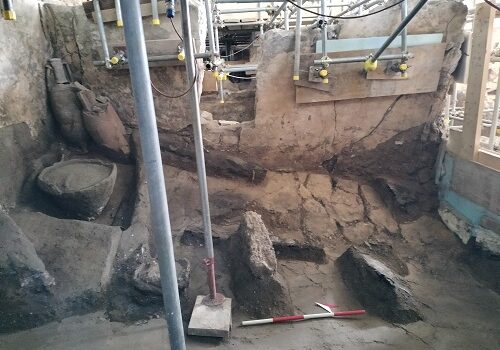
As published in the E-Journal of the Excavations of Pompeii https://pompeiisites.org/e-journal-degli-scavi-di-pompei/, amphorae with broad beans, one of which was half-empty, were found in one of the rooms on the first floor of the slave quarters of the large villa, as well as a large basket of fruit (pears, apples or sorb apples). They were precious vitamin supplements for men, women and children reduced to slavery, who lived in small rooms with a surface area of only 16 sq.m.. Each room contained up to three beds. Since they were regarded as the “means of production”, with their value capable of reaching several thousand sestertii, their owner had clearly thought of supplementing the diet of farm workers, based on wheat, with foodstuffs rich in vitamins, such as apples or pears, and proteins, such as broad beans.
The preservation of foodstuffs on the first floor, in an area where excavations will continue over the forthcoming months, probably had a twofold aim: firstly, foodstuffs enjoyed greater protection from parasites such as rodents. Since 2023, the remains of mice and rats have been found in the slaves’ accommodation on the ground floor, which was simply made of beaten earth rather than a proper floor. Moreover, it is likely that rationing was employed and there were therefore strict controls as to how much each person could take from the pantry, partly according to duties, age and sex. Such controls might have been easier to enforce by keeping provisions on the first floor, the area inhabited by trusted slaves of the master of the house who could check up on others, according to a complex system reconstructed previously on the basis of an analysis of the slave quarters (https://pompeiisites.org/e-journal-degli-scavi-di-pompei/of-mice-and-men/).
It is estimated that about 18,500 kilograms of flour a year would have been required for fifty workers, corresponding to the capacity of the slave quarters of Civita Giuliana, one of the largest known from the territory of ancient Pompeii. A surface area of about 25 hectares was necessary to produce this amount of flour. Nevertheless, in order to prevent the spread of diseases linked to malnutrition, it was essential to add other foodstuffs to the diet; this was the only way to ensure the full efficiency of the “speaking tools”. It was therefore conceivable that the slaves of the villas around Pompeii could have been more well-nourished than many formally free citizens, whose families lacked the wherewithal to make both ends meet and were therefore forced to beg from the eminent figures of the city.
The excavations focused on the northern sector of the slave quarters in the area occupied by the current road of Via Giuliana. Beneath this road, walls have come to light that belonged to the upper floors of the villa, in particular four rooms bordered by partition walls made of opus craticium.
The exploration of the rooms on the ground floor have brought to light the plaster cast of a leaf of a door, consisting of two rectangular panels with the iron bosses still intact, probably one of the leaves of a double-leaf door which led from the portico to a corridor that culminated in the entrance to the sacrarium. A second plaster cast appears to belong to the sphere of agricultural tools, possibly a plough or a handlebar (used to steer a plough drawn by animals).
Another plaster cast of considerable size could be interpreted as the leaf of a main door which, to judge from the recesses and slots on the upper long side, would have been a double-leaf door. Its position, tilted slightly towards the wall against which it was leant and its proximity to the so-called carpenter’s room, suggests that it might have either been waiting to be, or was in the process of being, repaired.
“There are cases like this in which the absurdity of the slave labour system becomes quite evident” observes Gabriel Zuchtriegel, the director of the Archaeological Park of Pompeii, co-author of the study of the slave quarters of Civita Giuliana. “Human beings were treated as tools, as machinery, but humanity cannot be so easily be erased. The boundary line between a slave and a freeman thus constantly risked vanishing: we breathe the same air, we eat the same things; sometimes slaves even ate better than so-called freemen. This explains why during this period authors such as Seneca and St Paul came up with the idea that we are all ultimately slaves in one sense or another, but we can all also be free, at least in our minds. It is a theme that does not belong exclusively to antiquity since slavery, in other forms or under other names, is still a reality at global level; according to some estimates, there are over 30 million people worldwide who live in conditions that can be classed as modern forms of slavery.”
Excavations have been carried out in the villa of Civita Giuliana since 2017 as a result of the collaboration with the Public Prosecutor’s Office of Torre Annunziata, which in 2019 was marked by the signing of a Memorandum of Understanding, renewed on several occasions, aimed at stopping the systematic looting of the villa which had been going on for years. The work carried out in 2023-24 focused on the urban stretch of road, exploring for the first time an area situated between the two sectors that were already known, the residential district to the north and the slave quarters to the south, in order to check the reliability of the information recovered by the judicial inquiries conducted by the Public Prosecutor’s Office.
The project “Demolition, excavation and enhancement in Civita Giuliana” financed with the Park’s ordinary funds is currently underway. It involves the demolition of two buildings that stand on the slave quarters only part of which is currently known. The excavation should make it possible to gain as complete and articulated a picture as possible of the plan and layout of the villa and its extension into the slave quarters, an element of crucial importance for defining new strategies for preserving and enhancing the whole of the area in question.


