

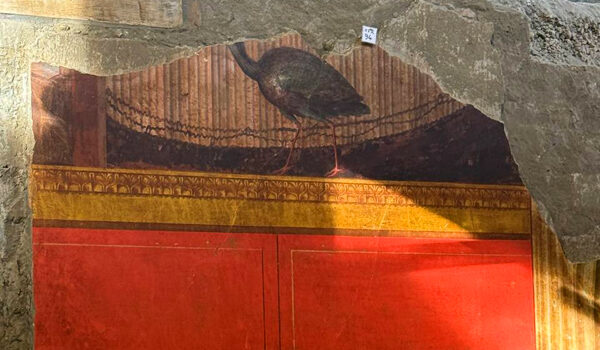
The elegant room of the theatre mask and the peacock in the Villa of Poppaea reveals its true size and sumptuous decoration. Frescoes are beginning to emerge from the site where excavations and restoration work are taking place
The first results from the current investigations are published today in the Park’s e-journal
Excavations and restoration are currently being carried out in the Villa of Poppaea at Oplontis-Torre Annunziata. The work is focusing on the famous oecus of the theatre mask and the peacock, one of the most elegant rooms in the villa, decorated in Second Style. The recent resumption of excavations has provided the first glimpses of refined frescoes, including brightly painted figures of peacocks and theatrical masks.
The intervention, prompted both by the need to clarify aspects related to the western sector of the villa that runs along the side of the urban stretch of Via dei Sepolcri and to solve conservation issues, also represents an important opportunity to enhance the archaeological and urban context. The current excavations will create a link with the adjoining Spolettificio Borbonico, the old Bourbon munitions factory where museum display areas, storerooms and additional facilities will be created over the next few years.
The first results of the research, including the completion of the excavation of the main hall, are illustrated in an article in the e-journal of the excavations of Pompeii https://pompeiisites.org/e-journal-degli-scavi-di-pompei/, published today.
“Despite the existing traces and the interpretative efforts made during the initial excavations, a great deal of uncertainty still surrounded the actual layout of this room and the rooms nearby. The current excavations may clarify the situation,” explains Gabriel Zuchtriegel, the Director of the Archaeological Park of Pompeii, “and also reveal new decoration with extraordinary details and colours, of which we have already had a tantalising foretaste.”
The particularly important discoveries include the whole figure of a peahen, the mirror image of the peacock found in the southern part of the same wall, and several fragments depicting a theatre mask referable to a character from the Atellan farces, in contrast to the others in the room linked to tragedy. The character in question is Pappus, a doddering old fool who tries to play the part of a young lad but always ends up being mocked and derided. An especially interesting discovery concerns several fragments of a fresco depicting part of a gilded tripod, inscribed in an oculus (circle), similar to the depiction in the centre of another wall where a bronze tripod is depicted.
Thanks to the technique of plaster casts, the excavations have also brought to light the imprints of trees that adorned the garden, in their original position and part of a precise ornamental design, which duplicated the colonnade of the south portico, evoking layouts recorded in the Pompeian domus and at the site of Oplontis itself. The tree species found in this room may have been similar to those identified in the archaeobotanical analyses carried out in the past in the adjoining rooms such as the olive tree.
The excavations have also led to the identification of four new rooms which can be added to the 99 ones already known, including an apsidal room that may well have formed part of a bathing complex. Another intriguing find is a paleo-stream channel, the bed of a seasonal stream that followed the course of via dei Sepolcri. It probably formed after the eruption of 1631, which eroded part of the deposits of the eruption of AD 79, providing a clearer picture of the surrounding landscape.
“The initial results provide promising new prospects for increasing our knowledge of the layout of the villa,” adds the Director, “and for the interactions between the human settlement and the natural environment over the long term.”
Restoration work is being undertaken concurrently with the excavations, aimed at restoring the decoration of two small, precious rooms, originally designed to be an area for relaxation, known as cubicula. The bedrooms look onto the south-west part of the Villa, very close to the other excavation. The strikingly ornate decoration, which consists of extraordinarily beautiful stuccoes, wall frescoes, painted vaults and mosaic floors, reveals, like the other rooms of the villa, the extremely sophisticated skills of the artists and artisans, and the varied range of colours, which also includes Egyptian blue.
The aim of the intervention is to restore all the details of the painted decoration and the mosaics, which have been lost over time due to the deterioration of the original materials and the alteration of the materials used in previous restoration work.
The first room is decorated with Second Style frescoes that depict faux marble and fanciful architectural features that give the illusion of more space; above, the vaults are decorated with coffer patterns, while landscapes are depicted in the lunettes. The mosaic floor is only partly preserved, with black and white tesserae that form geometric patterns. A narrow corridor leads to a seemingly more simple second room, decorated in Third Style with monochrome backgrounds and floral motifs. There must have originally been a false vaulted ceiling, of which very few traces remain. The second room, which displays several phases of work, some of which remained unfinished, would have probably been undergoing restoration work at the time of the eruption.
There are also plaster casts of the shutters of the doors and windows which were made at the time of the discovery of the rooms using the technique that derived from the one pioneered by Fiorelli and which still preserve original traces of the wood.
The restoration, which is nearing completion after almost a year of work, has achieved excellent results, bringing the frescoes and floors back to their original splendour, as well as revealing colours and details that were not previously visible. The completion of the cleaning and the removal of deteriorated material involves retouching the paintwork which will bring back to life and enhance the stunning decoration.


